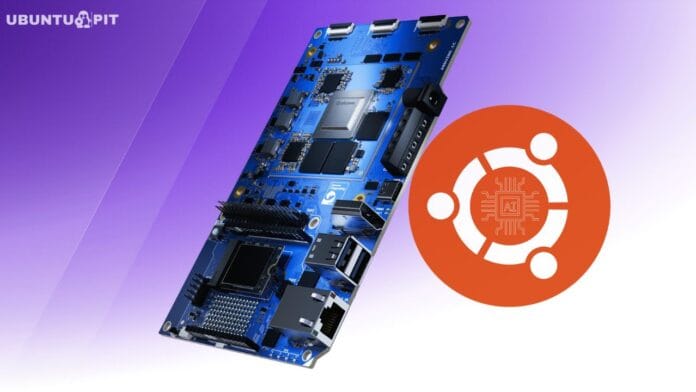
Arduino has introduced a powerful new single-board computer aimed at developers building intelligent machines. The Ventuno Q board runs Ubuntu Linux and focuses on edge AI workloads, enabling robotics, automation, and computer-vision projects to run advanced models directly on-device.
The newly revealed platform centers on Qualcomm’s AI-focused processor architecture. Built around the Dragonwing IQ-8275 processor, the board integrates CPU, GPU, and a dedicated neural processor capable of running complex AI workloads locally without relying on external servers. More technical details about the chipset can be found in the IQ-8275 platform specifications.
Designed for edge computing environments, the Ventuno Q targets scenarios where AI systems must respond immediately. Robotics platforms, industrial automation tools, and computer-vision systems often require real-time processing, and the board is engineered to support those conditions while keeping computation close to the device.
At the core of the device is AI acceleration delivering up to 40 TOPS of compute performance, enabling the system to process tasks such as vision analysis, speech recognition, and language models directly on the hardware. This level of performance allows AI inference to occur locally instead of being sent to cloud services.
The hardware configuration includes 16GB of LPDDR5 memory and 64GB of built-in eMMC storage, offering enough capacity to run large machine-learning models and handle multiple workloads simultaneously. Developers can also expand storage through an NVMe-compatible M.2 slot when additional space is needed.
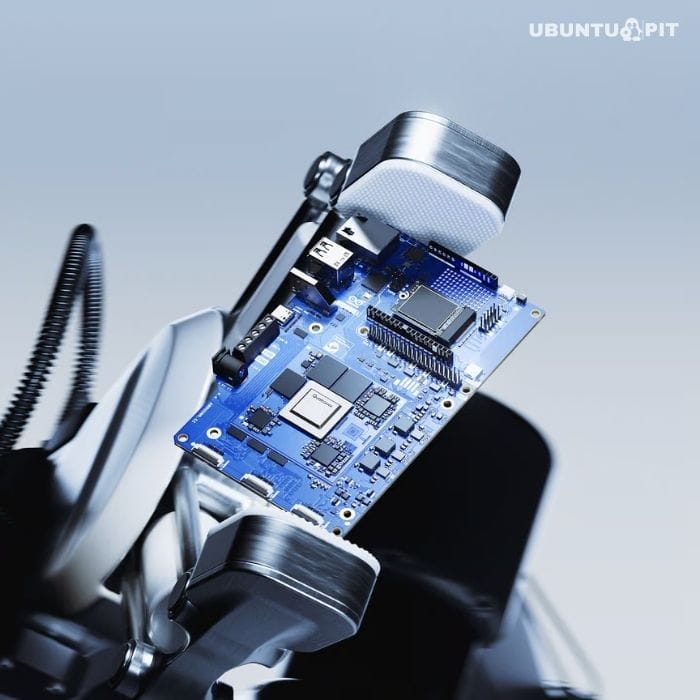
Networking and connectivity are designed for modern embedded systems as well. The board provides Wi-Fi 6, Bluetooth 5.3, and 2.5-gigabit Ethernet, ensuring fast communication with other devices and infrastructure used in robotics or industrial deployments.
One of the more notable design aspects is its dual-processor architecture. The main Qualcomm processor manages Linux workloads and AI inference, while a dedicated microcontroller handles time-critical operations such as sensor input, motion control, and other physical responses that require precise timing.
On the software side, Ventuno Q supports Linux distributions including Ubuntu and Debian, while the microcontroller runs Arduino’s real-time framework on Zephyr OS. This combination allows developers to build systems that mix Linux-based applications with deterministic control logic in the same device.
Development tools are also integrated to simplify experimentation. The board works with Arduino App Lab, an environment that supports Arduino sketches, Python programs, and AI models within a single workflow. Pre-built models for tasks like gesture recognition, object tracking, and speech processing can run entirely offline.
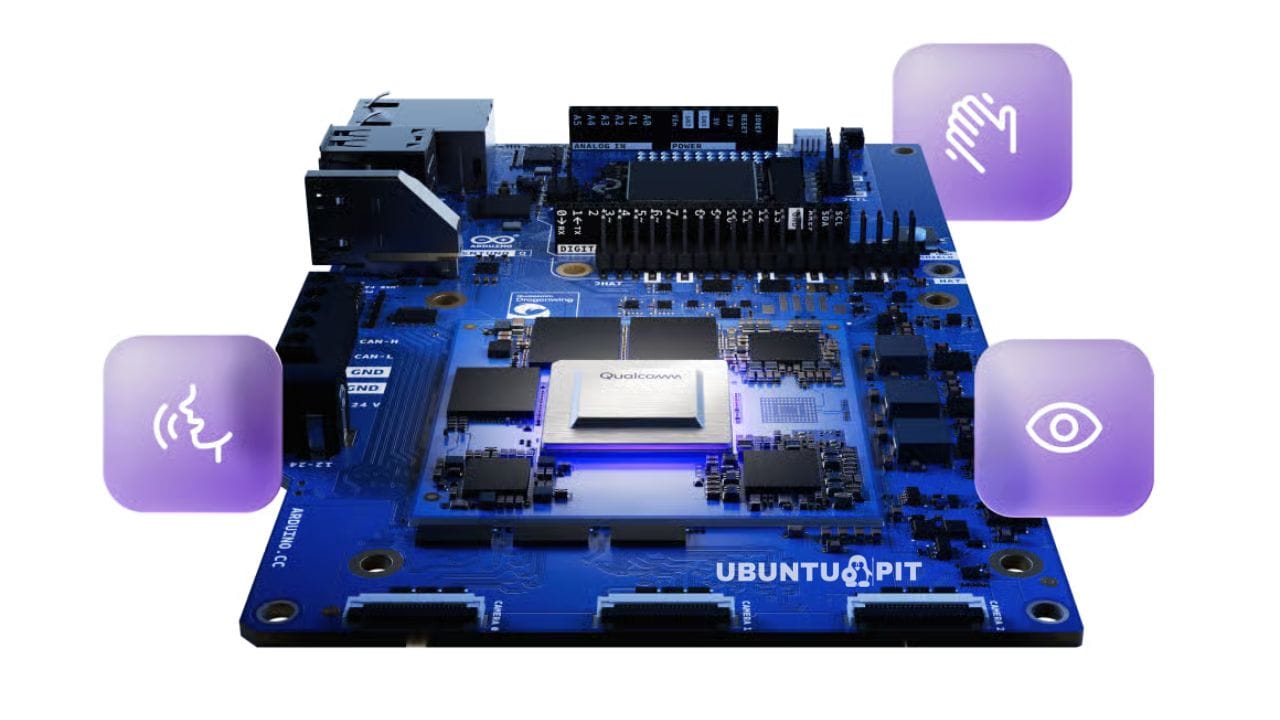
Hardware compatibility remains another key goal. Ventuno Q can interface with Arduino UNO shields, Raspberry Pi HAT expansions, and other sensor modules, giving developers flexibility when building prototypes or production systems.
With its focus on edge intelligence, the Ventuno Q represents an effort to move AI computation closer to the devices that interact with the physical world. By combining Linux, embedded control, and powerful neural processing on one board, the platform aims to simplify the development of autonomous systems.